Einstein–Casanova Unified Action Playground — v3
Interactive testbed for tuning each term of the Unified Lagrangian and attaching researcher notes for export.
How to use:
- Select scenario
- Toggle which fields are relevant
- Adjust strength sliders + scenario-specific inputs
- Add optional research notes
- Click Calculate + Add to Log
- Export JSON/CSV when ready
Scenario
Active Fields: Gravity, Gauge, Dark Matter, Dark Energy, Vacuum Energy, Warp Field, Consciousness.
Turn fields on or off with the checkboxes below. Use the sliders in the right-hand Sector Strengths panel to increase or decrease each contribution. When you are ready, click Calculate + Add to Log to record this setup in the Research Log, including the Mixed Regime column that shows whether the run was classical, mixed, or vacuum dominated.
Active Fields
Sector Strengths
Per-Scenario Inputs
Output
Research Log
| # | Scenario | Dominant Sector | Mixed Regime | S_eff | Notes |
|---|
Unified Action — Permanent Equation Image
This image stays here permanently as your master formula reference.
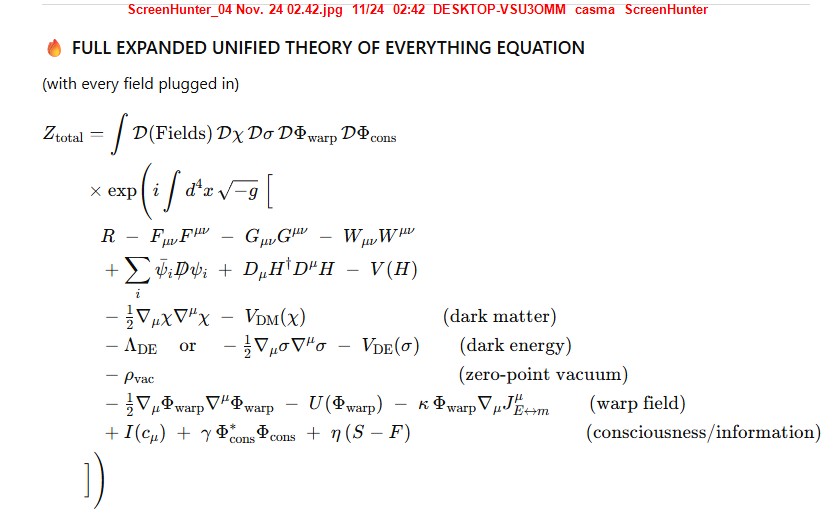
Einstein–Casanova Unified Action — Theory Explanation
The Einstein–Casanova Unified Action proposes that every major layer of reality — gravity, gauge forces, dark matter, dark energy, vacuum energy, warp metrics, and consciousness — belongs to one master field equation rather than a collection of separate, incompatible models. Instead of isolating these sectors the way standard physics often does, the theory treats them as energy-exchanging domains that strengthen or weaken one another depending on environment, scale, and symmetry-breaking conditions.
This playground works like a visual dial-board for that idea. By sliding the sector strengths and switching scenarios, you can watch how dominance shifts between classical physics (gravity + gauge + matter) and exotic physics (dark energy, vacuum, warp field, and consciousness coupling). When stability leans toward the classical side, the universe behaves in the familiar way we see in labs and telescopes. When the exotic side dominates, space-time becomes more flexible — hinting at regimes where vacuum manipulation, negative-energy corridors, mass↔energy reversibility, non-local warp bubbles, and long-range informational coupling might become relevant.
The model does not claim that faster-than-light travel or mind–matter interaction are experimentally proven. Instead, it identifies conditions under which they could emerge as logical extensions of a single action principle, rather than isolated “miracles.” In that sense, this simulator is not the engine itself — it is a map of the boundary where well-tested physics ends and genuinely new physics may begin.